Removals Action Guide: How to integrate removals into your business strategy

Carbon dioxide removals are essential for achieving the global goal of net zero. Organisations that have committed to this target have also implicitly committed to counterbalancing all their residual emissions with removals with durable storage. All IPCC mitigation pathways which limit global warming to 2°C or lower rely on some level of removals, paired with ambitious emission reductions. The global removals volume has increased over the past five years; however, there is still a huge gap to be closed until the required billions of tonnes per year are achieved by 2050. To achieve such volumes and required market maturity over the next 15-20 years, organisations need to start engaging in removals already now.

This guide is designed to help companies achieve this ambitious target. It outlines key actions for integrating removals into corporate climate action alongside rapid GHG emission reductions to reach net zero. It builds on the principles introduced in the Exponential Business Playbook in 2025 and focuses on strategies and actions needed to ensure businesses will have access to removals at the scale, cost and durability they need to address the anticipated residual emissions. The actions were developed in collaboration with Rethinking RemovalsOxford Net Zero, and Race to Zero.

Doers Club call on embedded removals

Carbon removals are usually discussed in terms of credits in voluntary markets, but there may be much larger opportunities to scale if they can be embedded directly into value chains and core business processes. This call was designed to explore what that could look like in practice, the barriers that exist today, and how companies and policymakers might help unlock the potential.

Doers call on making the CFO case for carbon removals

This call explored the challenges in getting CFOs on board with purchasing carbon removals and aimed to identify the key questions CFOs ask when presented with a carbon removal budget request. The goal is to develop robust answers to these questions over the coming months to help companies unlock funding for carbon removals.

CDR Durability: What counts as real climate impact?

🌍 CDR Durability: What Counts as Real Climate Impact?

🔀 LIKE it or not, the “like-for-like” debate in CDR isn’t going anywhere anytime soon. So much so that this isn’t even the first time we’ve covered this topic. But conversations around temporary vs. durable, conventional vs. novel removals are increasingly diverging.

🤔 Should we carve out separate roles for each in hashtagCarbonMarkets, or strive for a common ground that makes all removals comparable? Is true compatibility even possible?

🎙️ We are delighted to welcome the one and only Gabrielle Walker, co-founder of Rethinking Removals and CUR8 as our guest. Scientist-turned-CDR powerhouse, she has a deep understanding and passion for these topics like no other.

💬 Join as co-hosts Eve Tamme and Sebastian Manhart get into some of the nitty gritty of what “like-for-like” really means, why it matters for policy and net-zero claims, and how to build integrity with today’s knowledge.

TIME Magazine: Carbon Credits Should Be One of Our Best Tools to Fight Climate Change—If We Use Them Right

Carbon markets should be a fire hose for directing money where it’s genuinely needed in the climate crisis. But that will only happen if we rethink how we are using carbon credits.

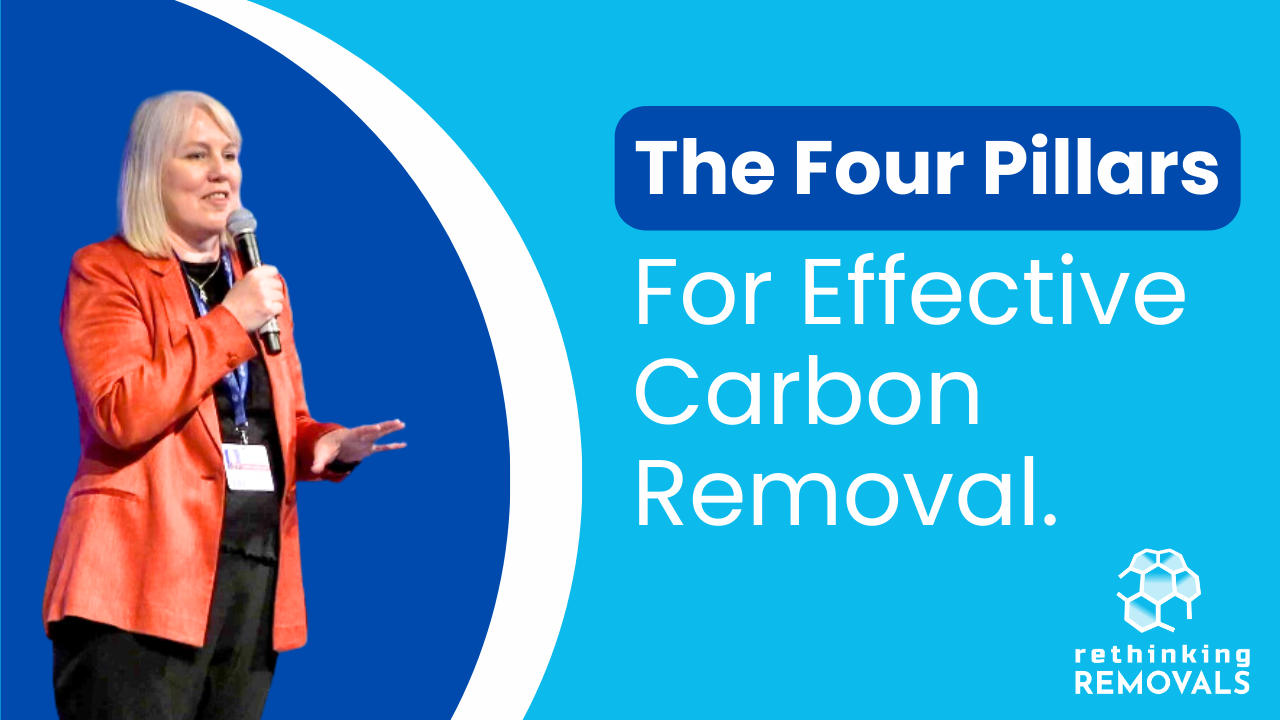
The four pillars for effective carbon removal

Gabrielle Walker takes the stage at COP28 in Dubai to lay out the 4 critical pillars that are foundational to reaching effective carbon removals at scale.